|
HIV/AIDS: The Problem

Scope of HIV / AIDS
Despite the abundance of international attention and extraordinary efforts to stem the growth of the HIV/AIDS pandemic, it remains a massive problem. At the end of 2007, UNAIDS estimated that 33.2 million people were living with HIV/AIDS worldwide, of which more than 85% were living in developing countries. Every day, 6,800 people become newly infected with HIV and 5,800 people die of AIDS. To put these numbers into perspective: the recent SARS epidemic lasted officially from November 2002 until July 2003 and over that time caused a worldwide scare and paralysis, received extraordinary government attention and media coverage, and cost millions of dollars in lost revenue. Yet, in the end, a total of 8,096 people were considered “probably infected with SARS” worldwide, of which 774 (9.6%) died. 1 2 3
Routes of Transmission
HIV transmission can occur when blood, semen, vaginal fluid, or breast milk from an infected person enters the body of an uninfected person. The most common ways that HIV is transmitted from one person to another are:
- Sexual intercourse with an infected person (vaginal, anal, oral).
- Unsafe medical practices including: blood transfusions with infected blood or blood clotting factors, reusage of unsterilized needles during vaccination drives, needle stick accidents in clinics.
- Sharing needles or injection equipment with an infected person.
- From the HIV-infected mother to the child, during delivery or breast feeding.
While most infections occur through sexual intercourse, recent studies highlight the problem of transmission caused by unsafe medical practices. A recent study conducted by the World Health Organization concluded that up to 39.9 % of all injections given in clinics in developing countries (excluding Latin America) are done with reused, unsterilized equipment. 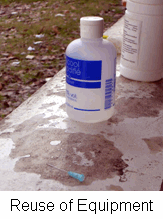 In some countries, such as India, the percentage of unsterilized reusage in hospital settings runs as high as 75%.4 Reusing unsterilized needles from one patient to another poses a great risk of transmission of a number of bloodborne diseases, including Hepatitis B, C, and HIV. Studies have shown that the chances of HIV transmission through a needlestick (provided blood contamination is present) amounts to 1/300 (Gerberding, 1995) or 30/1000. By contrast, the risk of sexual HIV transmission between an infected and non-infected partner runs between 1/1000 and 8/1000, depending on the levels of the virus in the blood of the infected person. While the exact percentage is still unknown, some studies estimate that up to 30% of HIV infections could be prevented if unsafe medical practices were corrected.5 6 In some countries, such as India, the percentage of unsterilized reusage in hospital settings runs as high as 75%.4 Reusing unsterilized needles from one patient to another poses a great risk of transmission of a number of bloodborne diseases, including Hepatitis B, C, and HIV. Studies have shown that the chances of HIV transmission through a needlestick (provided blood contamination is present) amounts to 1/300 (Gerberding, 1995) or 30/1000. By contrast, the risk of sexual HIV transmission between an infected and non-infected partner runs between 1/1000 and 8/1000, depending on the levels of the virus in the blood of the infected person. While the exact percentage is still unknown, some studies estimate that up to 30% of HIV infections could be prevented if unsafe medical practices were corrected.5 6
HIV Epidemic and Women
The characteristics of the HIV/AIDS pandemic are evolving. Recent studies have shown that the proportion of women infected with HIV is dramatically increasing worldwide. In particular, women in Asia, Africa, Eastern Europe and Central Asia are experiencing the feminization impact of HIV/AIDS epidemic. In some countries in Sub-Saharan Africa young women, ages 15 – 24, are at least 3 times more likely to be HIV-positive than men in the same age group. Behind this is both injection drug use and unprotected sex. 7
Barrier to Treatment, Care and Prevention: a lack of trained healthcare providers
In the US, there are 279 physicians for every 100,000 people (HIV prevalence rate: 0.6%). The picture is quite different in developing countries. Zimbabwe has 6 physicians / 100,000 people (HIV prevalence rate: 24.6%), Zambia: 7 / 100,000 (HIV prevalence rate: 16.5%), and Burundi: 1 / 100,000 (HIV prevalence rate: 6%). 8 9 A recent report by TREAT Asia (amfAR) highlighted that the shortage of doctors trained to properly administer AIDS medication is particularly acute all over Asia. For the countries where ICEHA works, the report shows that up until recently, there was just one trained doctor for every 11,250 HIV-infected patients in Vietnam, every 9,016 patients in India, and every 3,270 patients in Cambodia. 10 As mentioned in other sections of this website, one trained physician is able to provide adequate care to approximately 250 HIV-infected patients receiving antiretroviral medication, or to more than 300 HIV-infected patients not yet on therapy.
The lack of healthcare providers affects the battle against HIV/AIDS at a number of different levels:
- As antiretroviral medication becomes available at very low prices, the lack of healthcare professionals who have clinical expertise in HIV/AIDS and related syndromes has become one of the biggest barriers to effective treatment and prevention in developing countries. Not only does medication and funding remain unused in many cases because local healthcare providers lack the clinical expertise to identify and treat HIV-infected patients, but also, in those cases where the medication does get used, it is done so in incorrect ways that lead to a lack of effectiveness and a risk that the virus becomes resistant to all existing medications.
- The lack of clinical expertise also hampers effective HIV prevention messages from being communicated using the broad reach of healthcare systems. While HIV prevention programs are currently run primarily through grassroots organizations and advocacy programs, very few messages are reinforced through healthcare systems. This is particularly important because healthcare workers are in an ideal position to reinforce prevention messages, since they have access to many of the people who are at risk of contracting HIV and since they are considered trustworthy and their advice is taken seriously.
- Finally, operational systems necessary for good patient care are frequently lacking in developing countries, including systems to conduct monitoring of patients and treatment, provide patient counseling, maintain patient confidentiality, ensure reliable drug distribution and accountability and ensure safe medical practices such as the use of clean needles. As recent studies have pointed out, up to 39.9% of all injections given in hospital settings in developing countries are done with reused, unsterilized needles, which put patients at a great risk of contracting the virus. Obviously, this is a major contributor to the transmission of infectious diseases, yet one that can easily be rectified.
- WHO publication “Summary of probable SARS cases with onset of illness from November 1, 2002 – July 31, 2003.” www.who.int/csr/sars/country/tables2004_04_21/en/
- Charles M., Boyle B. “The HIV pandemic: power of acting early.” AIDS Reader, 14.6 (July 2004).
- UNAIDS/WHO: AIDS Epidemic Update. December 2007. http://www.unaids.org/en/HIV_data/2007EpiUpdate/default.asp
- Hutin YJF, Hauri AM, Armstrong GL. “Use of injections in healthcare settings worldwide, 2000: literature review and regional estimates.” British Medical Journal, 327.8 (November 2003). www.bmj.com
- Gisselquist D, Rothenberg R, Potterat J, Drucker E. “HIV infections in Sub-Saharan Africa not explained by sexual or vertical transmission.” International Journal of STD & AIDS, 13.10 (October 2002): 657-666.
- Berkley S. “Parenteral transmission of HIV in Africa.” AIDS 1991: 5 (suppl) S87-92.
- UNAIDS/WHO: AIDS Epidemic Update. December 2005. http://www.who.int/hiv/epiupdate2005/en/index.html
- UNAIDS: AIDS Epidemic Update. December 2004. www.unaids.org
- UNDP. Human Development Report 2004, pg. 156 - 159. www.undp.org/hdr2004
- TREAT Asia Special Report: Expanded Availability of HIV/AIDS Drugs in Asia Creates Urgent Need for Trained Doctors. July 2004. http://www.amfar.org/cgi-bin/iowa/asia/index.html
|